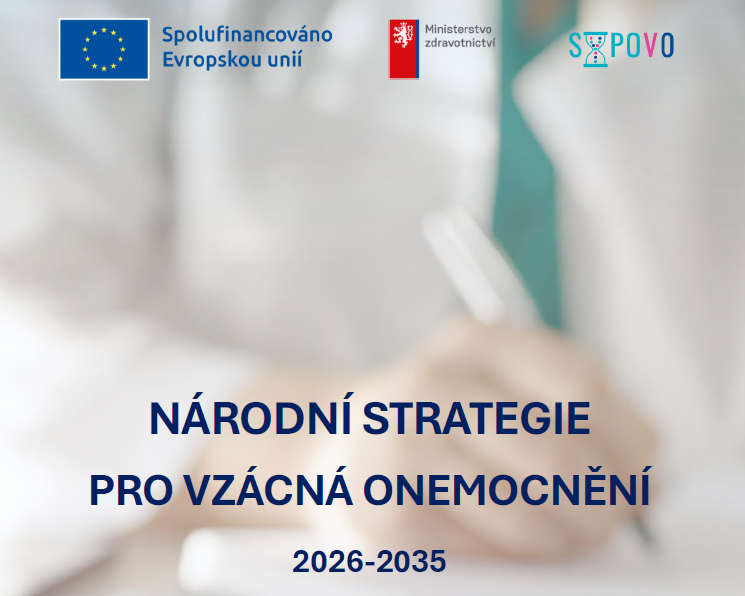
On 30 March, the Government of the Czech Republic adopted a new document: "National Strategy for Rare Diseases 2026-2035". This is an important step for furthering the development of care for people with rare diseases in the Czech Republic. The strategy builds on the previous period and puts new emphasis on coordinated, data-driven and patient-centred care, which takes into account not only the health but also the social needs of patients and their families.
According to the document, there are up to 500,000 people with a rare disease in the Czech Republic, i.e. around 5% of the population. Therefore, the strategy rightly assumes that care for this patient community must be long-term, interdisciplinary and better interconnected across healthcare and social services.
The new strategy is built on five main objectives:
From the perspective of patients and families, the most important topics include: better information, shorter diagnostic journeys, continuity of services, development of specialised care and stronger links between health and social areas. The strategy also outlines a plan to establish the National Registry of Rare Diseases and to improve the use of data for planning and evaluation of care.
The introduction of the care coordinator role is one of the most important new features expected. The strategy openly states that the lack of coordination is one of the main weaknesses of the system today and that it is necessary to systematically build this role.
The care coordinator should act mainly in Centres of Highly Specialised Care for Rare Diseases (CVSP-VO). He or she should be the contact person for the patient and the family in practical and organisational matters, should assist with the follow-up of examinations, check-ups and communication between professionals, and supervise the continuity of care according to an individual plan. At the same time, the strategy emphasises that this is not an occasional extra help, but a role with clearly defined competencies, methodology, capacity model and education.
Equally important, the strategy goes beyond coordination within specialised centres and also closer cooperation between the Centres of Expertise and regional care and support providers. The document describes a model in which the centre coordinator will collaborate with the community or regional coordinator where the patient lives. Together, they will ensure the continuity of care between the centre and the region.
This is an essential step for families. Regional coordination is intended to help with follow-up services, home care, rehabilitation, psychological or social support, assistance in education, early care or return to work. The strategy thus clearly confirms that quality care for rare diseases cannot end at the door of a specialised centre, but must be well connected to the everyday life of the patient in his region.
At the same time, HAE Junior welcomes the fact that the strategy prioritises the active involvement of patients and patient organisations. The document explicitly identifies patient organisations as key stakeholders and emphasises that their involvement in the implementation and evaluation of the strategy is a crucial prerequisite for long-term sustainability and trust in the system.
The strategy itself reminds us that patient organisations should be partners in education, information, designing care and systemic changes.
We consider this to be essential. Without the experience of patients and caregivers, it is impossible to establish a system that effectively addresses the genuine needs of people living with a rare disease.
The strategy itself serves as a framework document. Specific steps, deadlines and methods of implementation will be further elaborated in the implementation plans. However, it has already become obvious that the new strategy creates a vital foundation for better coordinated care for patients with rare diseases in the Czech Republic.
On behalf of HAE Junior, we will closely monitor further developments. We are confident that we will be able to translate strategic priorities into practice so that patients and their families feel real improvements in the near future — especially in the area of care coordination, connecting centres of expertise with regions, as well as stronger involvement of the patient community.
You can send your financial donation also to our bank account 2001782429/2010.












National & international affiliations: